A sneaker with three stripes of color and a July 11 release date shows what trademark law still can’t see: borrowed meaning.
Allen Adamson is Co-Founder of Metaforce, Brand Expert-in-Residence at the Berkley Center for Entrepreneurship at NYU Stern, and an expert witness in trademark, branding, and consumer perception disputes.
This article examines how Nike used 7-Eleven’s colors, imagery, and release timing to borrow the brand’s meaning—and what the dispute reveals about the limits of trademark law.
Originally published November 1, 2026 in Law Journal Newsletters.
The most talked-about sneaker Nike released this summer never made it to a store. In June, resale platforms listed the upcoming Air Max 95 “Big Bubble” at an average of $161, well below its $210 retail price. Demand was soft. Then 7-Eleven sued. Within eight days, the same shoe was trading at $439. The lawsuit outperformed the product.
The case, filed July 1 in federal court in Texas, is not a typical trademark fight. There is no counterfeit logo. There is no copied name. Nike never used either. Instead, Nike dressed the sneaker in orange, green, and red, a color combination 7-Eleven has used since 1987 and holds as a federally registered trademark. Nike scheduled the release for July 11, the chain’s signature holiday, when it gives away free Slurpees. The insole carried store-shelf graphics. Nike’s own marketing copy called the shoe “the flyest way to get around, even if you’re just strolling down to the corner store for a quick snack.”
Sneaker media needed no prompting. Months before the suit, every outlet covering the release called it “the 7-Eleven.” Nike never said the name. It didn’t have to. Consumers completed the connection on their own. That was the point.
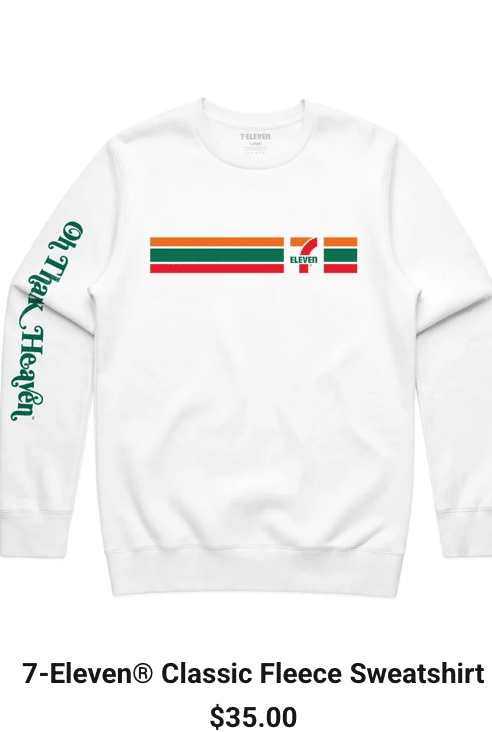
Here is the brand strategist’s read. If Nike had taken only the colors, 7-Eleven would have a harder argument. Plenty of brands use orange, green, and red. But 7-Eleven has built a broad house style off its 7 and those three stripes, and Nike took the look at its core. Walk through 7-Eleven’s own online store and you will find a $35 fleece sweatshirt with the same horizontal tri-stripe band across the chest. The chain already sells its identity as apparel. Nike put that identity on a competing wearable product. Then the launch date removed any doubt. A release on 7/11, wrapped in corner-store imagery, told consumers exactly which brand to think of. Nike didn’t just borrow the equity. It helped shoppers make the connection, and they did.
For trademark lawyers, though, the evidence cuts in two directions, and that is what makes this case worth watching. The doctrine turns on confusion. Did consumers believe 7-Eleven sponsored or approved the shoe? The sneaker community made the association instantly and universally, but much of the coverage also noted the shoe did not appear to be an official collaboration. In other words, consumers knew exactly whose brand it was and knew the brand hadn’t agreed. Association without confusion. The meaning was plainly taken. Whether the law can see the taking is the open question.
What surprises me most is who did the taking. Nike understands better than almost any company on earth how brands are built and what they are worth. It has done this the right way before. Its licensed collaboration with Ben & Jerry’s, the “Chunky Dunky” Dunk, became one of the most coveted sneakers of its era precisely because both brands promoted it together. And Nike is famously aggressive when others borrow its own equity. It has sued artists and upstarts for far less. Yet here, 7-Eleven says it reached out privately and Nike kept going. The company that polices brand rent harder than anyone decided, this one time, not to pay it.
The irony is that a license would have been better business. The soft pre-suit resale numbers show the unauthorized homage wasn’t selling on its own. A true 7-Eleven x Nike partnership, launched on Slurpee day with both companies’ marketing muscle behind it, would likely have sold through at retail and beyond. Instead, Nike pulled the shoe from its app the night the suit went public, retailers canceled their raffles, and the only people who profited were resellers flipping a canceled curiosity.
Then, on October 19, the case ended the way these cases almost always end. 7-Eleven dismissed it with prejudice, which means it can never bring the same claims again. Each side pays its own lawyers. No terms were disclosed. No judge ruled on whether three stripes and a release date add up to infringement. Sneaker sites now report the shoe has reappeared on retailer calendars, which suggests the two companies reached a private arrangement, though neither has said so.
That is the pattern, and it is the problem. Lululemon and Costco left the courtroom the same way, quietly, with the most valuable asset in the room never appraised. When a case like this settles, the public record ends with a question and no answer. Brand owners learn nothing about what the law will protect. Borrowers learn that the worst outcome is a canceled launch and a confidential check. And the meaning at the center of the dispute, decades of corner-store associations built one Slurpee at a time, is never priced by anyone outside a closed-door negotiation.
The question is bigger than one sneaker. Trademark law has a test for confusion. It has no vocabulary for borrowed meaning, for the Slurpee-and-summer-nights associations that took decades and billions of impressions to build. Nike never used the name. It took the meaning. The case that might have forced to put a number on that is gone. Until the law learns to price it, the smartest brand builders will keep finding ways to rent equity without ever signing a lease, and the smartest landlords will keep settling in private.